Hydrocloric Acid, 34-37% OmniTrace®, EMD Millipore Sigma
You have not viewed any products recently.
View Larger
- There are no alternate images available for this product.
- There are no alternate images available for this product.
Hydrocloric Acid, 34-37% OmniTrace®, EMD Millipore Sigma
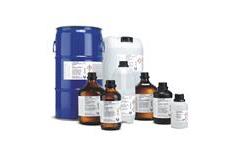
34-37% OmniTrace® Hydrocloric Acid. The 500mL size is packaged in a poly coated glass bottle and 2.5L size is packaged in a poly bottle. Key Applications are General Chemistry
Formula: HCl in water
| Appearance |
Clear |
| Aluminum (Al) |
1ppb max |
| Antimony (Sb) |
0.5ppb max |
| Arsenic (As) |
0.5ppb max |
| Assay |
34-37% |
| Barium (Ba) |
0.1ppb max |
| Beryllium (Be) |
0.1ppb max |
| Bismuth (Bi) |
0.1ppb max |
| Boron (B) |
1ppb max |
| Bromide (Br) |
10ppm max |
| Cadmium (Cd) |
0.1ppb max |
| Calcium (Ca) |
1ppb max |
| Cerium (Ce) |
0.1ppb max |
| Cesium (Cs) |
0.1ppb max |
| Chromium (Cr) |
0.5ppb max |
| Cobalt (Co) |
0.1ppb max |
| Color (APHA) |
10 max |
| Copper (Cu) |
0.5ppb max |
| Density at 25°C |
1.17-1.18g/ml |
| Dysprosium (Dy) |
0.1ppb max |
| Erbium (Er) |
0.1ppb max |
| Europium (Eu) |
0.1ppb max |
| Free chlorine (as Cl) |
0.5ppm max |
| Gadolinium (Gd) |
0.1ppb max |
| Gallium (Ga) |
0.1ppb max |
| Gold (Au) |
0.5ppb max |
| Hafnium (Hf) |
0.1ppb max |
| Holmium (Ho) |
0.1ppb max |
| Indium (In) |
0.1ppb max |
| Iron (Fe) |
1ppb max |
| Lanthanum (La) |
0.1ppb max |
| Lead (Pb) |
0.1ppb max |
| Lithium (Li) |
0.1ppb max |
| Lutetium (Lu) |
0.1ppb max |
| Magnesium (Mg) |
0.5ppb max |
| Manganese (Mn) |
0.1ppb max |
| Mercury (Hg) |
0.1ppb max |
| Molybdenum (Mo) |
0.1ppb max |
| Neodymium (Nd) |
0.1ppb max |
| Nickel (Ni) |
0.5ppb max |
| Niobium (Nb) |
0.1ppb max |
| Potassium (K) |
1ppb max |
| Praseodymium (Pr) |
0.1ppb max |
| Rhenium (Re) |
0.1ppb max |
| Rhodium (Rh) |
0.1ppb max |
| Rubidium (Rb) |
0.1ppb max |
| Ruthenium (Ru) |
0.1ppb max |
| Samarium (Sm) |
0.1ppb max |
| Scandium (Sc) |
0.1ppb max |
| Selenium (Se) |
1ppb max |
| Silver (Ag) |
1ppb max |
| Sodium (Na) |
1ppb max |
| Strontium (Sr) |
0.1ppb max |
| Tellurium (Te) |
0.1ppb max |
| Terbium (Tb) |
0.1ppb max |
| Thallium (Tl) |
0.1ppb max |
| Thorium (Th) |
0.1ppb max |
| Thulium (Tm) |
0.1ppb max |
| Tin (Sn) |
0.5ppb max |
| Titanium (Ti) |
0.5ppb max |
| Total phosphorus (P) |
0.01ppm max |
| Total sulfur (as S) |
0.3ppm max |
| Tungsten (W) |
0.1ppb max |
| Uranium (U) |
0.1ppb max |
| Vanadium (V) |
0.5ppb max |
| Ytterbium (Yb) |
0.1ppb max |
| Yttrium (Y) |
0.1ppb max |
| Zinc (Zn) |
1ppb max |
| Zirconium (Zr) |
0.1ppb max |
| pH value |
<1 (H2O, 20°C) |
| Vapor pressure |
190 hPa (20 °C) |
| Safety Information- GHS |
| Storage Class |
8B Non-combustible, corrosive hazardous materials |
| WGK |
WGK 1 slightly hazardous to water |
| Disposal |
12- Inorganic acids and anhydrides thereof should first be diluted or hydrolyzed by stirring carefully into ice water and then neutralized (protective gloves, fume cupboard!) with sodium hydroxide solution. Before filling into container D, check the pH with pH universal indicator strips. Fuming sulfuric acid should be carefully stirred dropwise into 40% sulfuric acid. Ensure that plenty of ice is available for cooling! When sufficiently cool, treat the highly concentrated sulfuric acid as described above. Analogous to this procedure, other anhydrides can be converted into their corresponding acids. Acid gases (e.g. hydrogen halide, chlorine, phosgene, sulfur dioxide) can be introduced into dilute sodium hydroxide solution and after neutralization disposed of in container D. |